nf-core/daamicrobiome
Microbiome differential abundance consensus pipeline
Introduction
nf-core/daamicrobiome is a bioinformatics pipeline for microbiome differential abundance (DA) analysis that runs multiple DA tools in parallel and combines their results into a consensus. It takes a phyloseq RDS object as input and supports two analysis paths:
- Path A — k-intersection consensus: runs DA tools on real data and reports taxa called differentially abundant by at least k tools in agreement.
- Path B — simulation-based weighted consensus (default): uses MIDASim to generate ground-truth simulated datasets from control samples, scores each DA tool’s performance on these simulations, and applies the learned per-tool weights to the real-data results.
DA tools included
| Tool | Reference |
|---|---|
| ADAPT | Wang & Mukai, 2024 |
| corncob | Martin et al., 2020 |
| LinDA | Zhou et al., 2022 |
| LOCOM | Hu et al., 2022 |
| MaAsLin2 | Mallick et al., 2021 |
| metagenomeSeq | Paulson et al., 2013 |
Pipeline overview
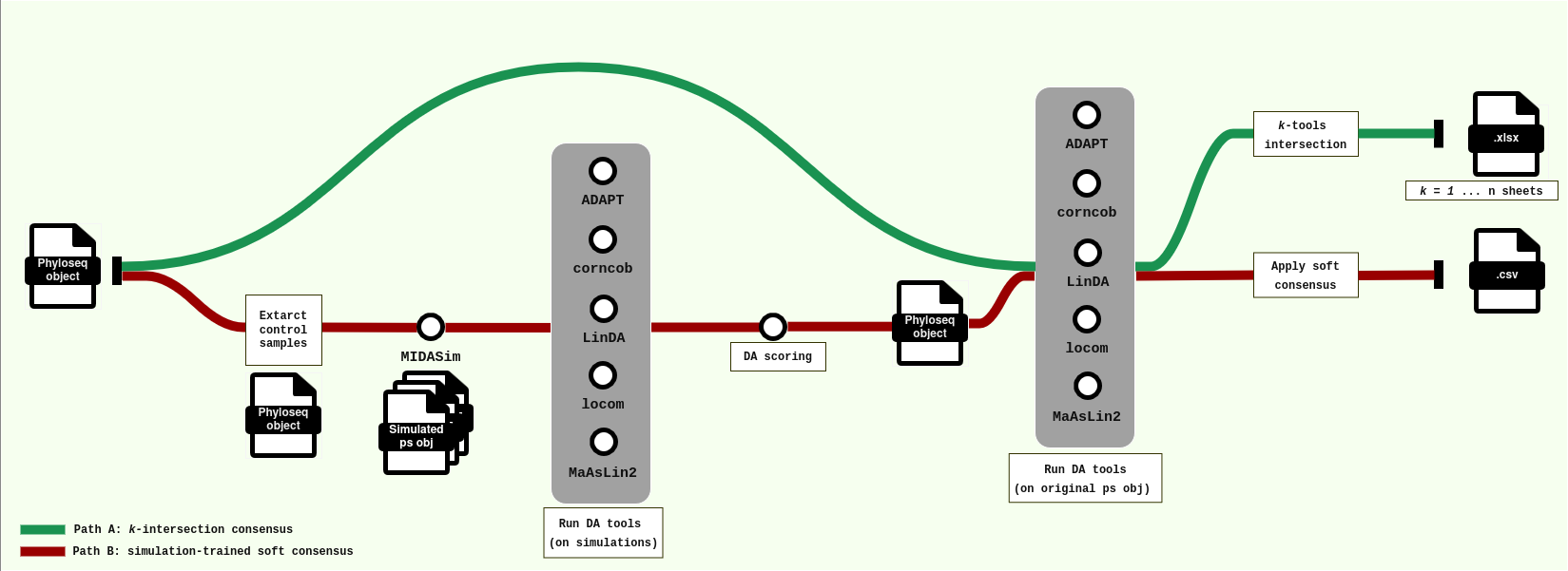
- Control extraction (Path B) — subset control/healthy samples from the input phyloseq (or use a provided control-only object)
- Simulation (Path B) — generate ground-truth datasets with known DA taxa via MIDASim
- DA analysis — run the enabled DA tools on simulated and/or real data
- Scoring (Path B) — evaluate each tool’s sensitivity, specificity, and FDR on simulations to derive per-tool weights
- Consensus — combine results via weighted consensus (Path B) or k-intersection (Path A)
Usage
If you are new to Nextflow and nf-core, please refer to this page on how to set-up Nextflow. Make sure to test your setup with -profile test before running the workflow on actual data.
Input
The pipeline requires a phyloseq RDS object (.RDS) containing an OTU/ASV count table, sample metadata with a condition/group column, and a taxonomy table.
Path A: k-intersection consensus
nextflow run nf-core/daamicrobiome \ -profile docker \ --input phyloseq.RDS \ --simulate false \ --condition "study_condition" \ --base_level "healthy" \ --outdir results/Path B: simulation-trained weighted consensus (default)
nextflow run nf-core/daamicrobiome \ -profile docker \ --input phyloseq.RDS \ --simulate true \ --condition "study_condition" \ --base_level "healthy" \ --outdir results/Please provide pipeline parameters via the CLI or Nextflow -params-file option. Custom config files including those provided by the -c Nextflow option can be used to provide any configuration except for parameters; see docs.
For the full list of parameters (DA tool toggles, simulation settings, scoring thresholds, resource limits), please refer to the usage documentation and the parameter documentation.
Pipeline output
To see the results of an example test run with a full size dataset refer to the results tab on the nf-core website pipeline page. For more details about the output files and reports, please refer to the output documentation.
Credits
nf-core/daamicrobiome was originally written by Martina Cardinali and Toni Gabaldón.
We thank the following people for their extensive assistance in the development of this pipeline:
Contributions and Support
If you would like to contribute to this pipeline, please see the contributing guidelines.
For further information or help, don’t hesitate to get in touch on the Slack #daamicrobiome channel (you can join with this invite).
Citations
An extensive list of references for the tools used by the pipeline can be found in the CITATIONS.md file.
You can cite the nf-core publication as follows:
The nf-core framework for community-curated bioinformatics pipelines.
Philip Ewels, Alexander Peltzer, Sven Fillinger, Harshil Patel, Johannes Alneberg, Andreas Wilm, Maxime Ulysse Garcia, Paolo Di Tommaso & Sven Nahnsen.
Nat Biotechnol. 2020 Feb 13. doi: 10.1038/s41587-020-0439-x.